Jul. 07, 2026
Most buyers sourcing from Asia have heard of BSCI. Many require it. Fewer understand what it actually means.
Here is a fact that surprises most buyers: BSCI does not issue certificates. It is not a certification at all. It is a verification system that evaluates whether a factory meets social compliance standards.
For buyers, this distinction matters. A "BSCI-certified factory" is not a thing that exists. There are only factories that have passed a BSCI audit within a certain time frame. Understanding what that audit actually covers — and what it does not cover — is the difference between a real supplier and one that simply knows the right words to say.
Here is what the audit covers, what the factory has to provide, and what buyers should actually look for in a BSCI report.
BSCI stands for Business Social Compliance Initiative. It was established in 2003 by the Foreign Trade Association (now amfori). Today, amfori conducts over 37,000 BSCI audits annually to support companies in supply chain due diligence.
The BSCI Code of Conduct is based on international standards: OECD guidelines, UN Guiding Principles on Business and Human Rights, and ILO conventions. The audit assesses factories against 13 Performance Areas covering everything from working hours to environmental protection.
One thing to get straight: BSCI is not a product test. It is a social compliance audit. It evaluates how a factory operates — working conditions, management systems, labor practices — but it says nothing about whether the candle itself is safe. That is a different set of requirements.

The amfori BSCI audit evaluates 13 Performance Areas across four broad categories:
Social Management & Workplace Relations (PA 1-4)
PA 1: Social Management System & Cascade Effect
PA 2: Workers Involvement and Protection
PA 3: Freedom of Association and Collective Bargaining
PA 4: No Discrimination, Violence or Harassment
Employee Well-being & Fair Practices (PA 5-7)
PA 5: Fair Remuneration
PA 6: Decent Working Hours
PA 7: Occupational Health and Safety
Protection of Vulnerable Workers (PA 8-11)
PA 8: No Child Labour
PA 9: Special Protection for Young Workers
PA 10: No Precarious Employment
PA 11: No Bonded, Forced Labour or Human Trafficking
Ethical Practices (PA 12-13)
PA 12: Protection of the Environment
PA 13: Ethical Business Behaviour
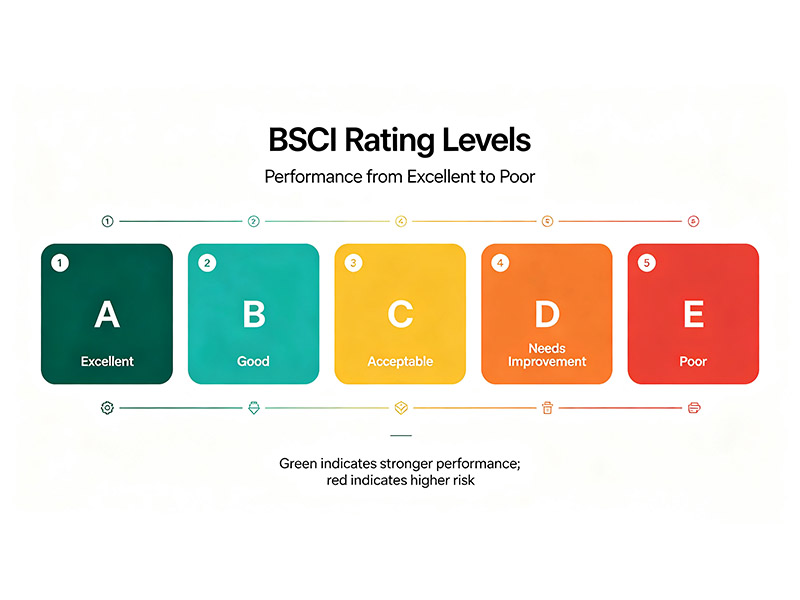
The audit includes 81 questions across these areas. Each is rated "yes," "no," "partial," or "not applicable." The final result is an audit report with a rating from A to E.
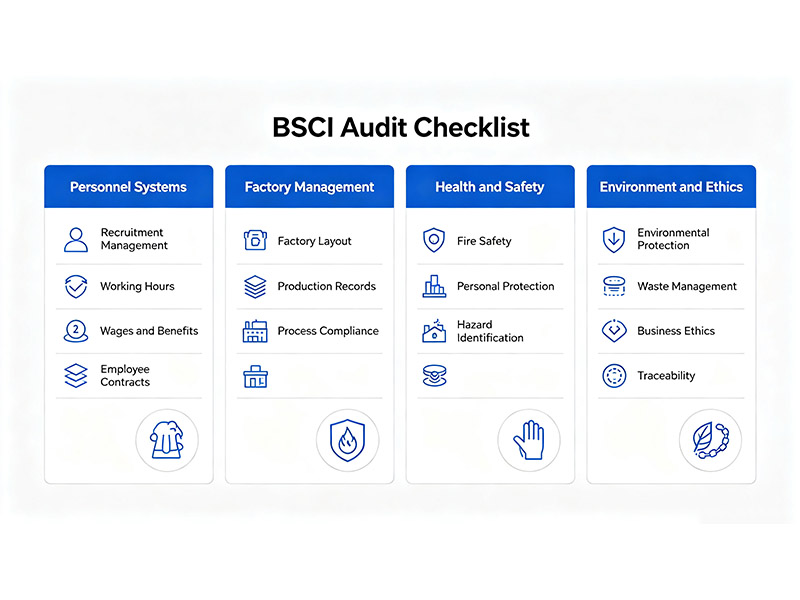
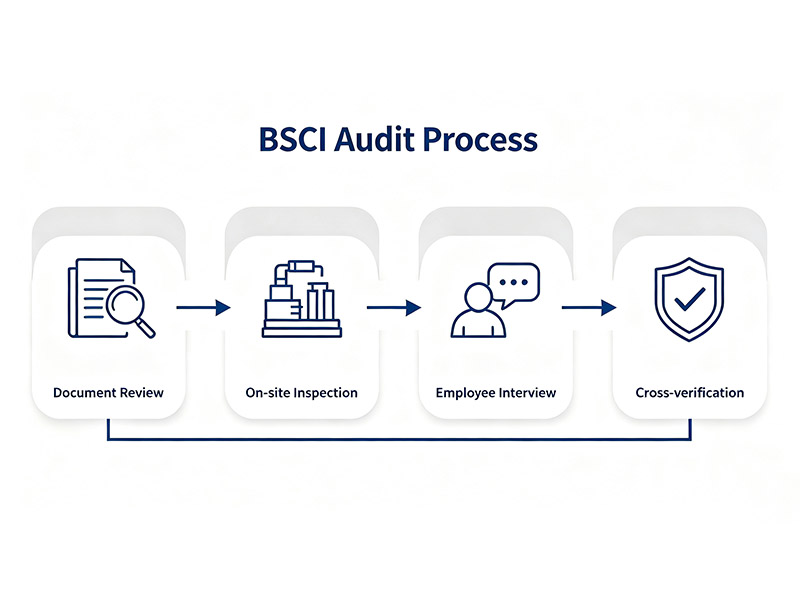
The audit process is more thorough than most buyers realize.
First: documentation review. The factory must provide extensive documentation:
Business license and organizational chart
Factory floor plan and fire evacuation map
All employee personnel files and labor contracts
12 months of attendance, overtime, and payroll records
Social insurance payment receipts
Special equipment inspection certificates
Fire drill and safety training records
Chemical inventory and safety data sheets
Environmental permits and waste disposal records
Second: on-site inspection. Auditors walk through every area of the factory — production floor, warehouse, dormitories, canteen. They check for fire safety, machine guarding, chemical storage, and basic working conditions.
Third: worker interviews. Auditors speak with workers privately. They verify whether working hours match records. Whether wages are paid correctly. Whether workers know safety procedures. Whether they can report grievances without fear of retaliation.
Fourth: verification of evidence. The audit uses triangulation across three sources — documentation, site observation, and worker interviews. If the hours in the payroll records do not match what workers describe, the factory gets flagged.
Product safety. BSCI does not test candles for fire safety, soot emissions, or chemical content. That is EN 15493, EN 15426, and REACH.
Quality control. BSCI does not check whether candles burn clean, stay lit, or arrive in good condition.
Certification. BSCI does not issue certificates. A factory receives an audit report with a rating. That report is valid for two years, but it is not a certificate.
The BSCI audit cycle is two years:
Full audit. The initial comprehensive audit covering all 81 questions. Rating: A, B, C, D, or E.
Follow-up audit. If the rating is C, D, or E, the factory must undergo a follow-up audit within 2 to 12 months. The follow-up focuses only on areas that need improvement.
Next full audit. If the rating is A or B, the next full audit is due within two years.
Important change: As of September 2024, amfori no longer accepts fully announced audits. Audits are semi-announced or unannounced only.

Look at the rating, not the pass/fail. There is no pass or fail in BSCI. There is only a rating from A to E. A rating of C or above is generally accepted by retailers, but C means "improvement needed." Some buyers require B or higher.
Check the report date. BSCI reports are valid for two years. A report from three years ago tells you nothing about current conditions.
Verify the report is real. Audit reports are only accessible through the amfori Sustainability Platform. A PDF shared by a supplier can be edited. If compliance matters, ask for access to the platform or verify the report ID with the auditing company. Reliance on screenshots or PDF copies without platform verification is a common source of misjudgment.
Ask about follow-up audits. A rating of C, D, or E requires a follow-up within 12 months. If the factory has not scheduled one, that is a red flag.
A BSCI audit should be treated as a starting point. Additional verification should include:
Product compliance testing (EN 15493, EN 15426, REACH where applicable)
Quality control inspections during production
Verification of subcontracting practices
Direct communication with factory management
Factories that cannot support these additional layers of verification present elevated risk.

BSCI is a baseline, not a guarantee. It tells you the factory passed a social compliance audit at a specific point in time. It does not tell you whether the factory runs consistently well every day. It does not tell you whether the product is safe.
A factory with a valid BSCI report can still fail a shipment due to product safety issues, inconsistent quality, or undocumented subcontracting.
Factories that maintain BSCI audits are not automatically good. They have simply demonstrated that they can meet basic social compliance standards when audited. That is a useful screen, but it is not a complete evaluation.
Buyers who rely only on BSCI reports are missing the full picture. A compliant factory can still deliver poor product quality. A compliant factory can still have hidden issues between audits.
The smartest buyers use BSCI as a starting point, not an endpoint. Combine it with product testing, quality audits, and direct communication. That is how you separate real suppliers from the rest.
Kelaisi Candle has been manufacturing candles since 1991, with production facilities in Xingtai and Shijiazhuang, Hebei. BSCI audit reports, along with supporting documentation and follow-up records, can be provided upon request.
 Big size decorative scented candle
 Christmas Scented Candles Gifts Sets for Women
 happy birthday long thin glitter cake candles
 Luxury Golden Birthday Number Candle Sets
 Fancy cake decoration number annual birthday candle
 Gradient color Soy Wax Glass Jar Scented Candle
 Origami Style Vertical Pattern Wine Glasses Jar Candles
 Custom Mini Glass Jar Scented Candle
 3D Letter Happy Birthday Candles
 Decorative Birthday Candles
 St. Patrick's Day Decorations Set
 Christmas Party Balloons Supplies