Oct. 14, 2026
For a wholesale buyer, approving a product sample is only the beginning. The real challenge comes when the same product needs to be manufactured again months later, with the same appearance and the same expectations.
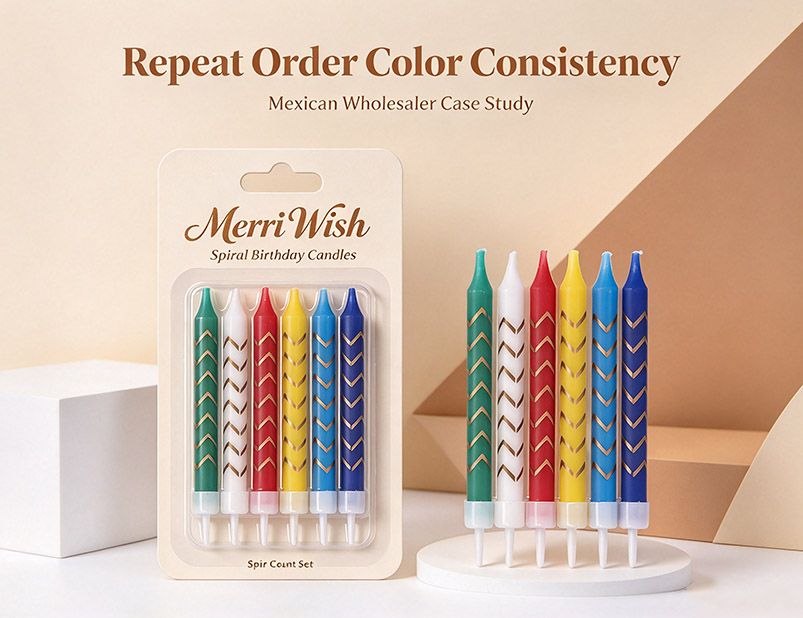
A Mexican wholesale customer worked with Kelaisi Candle on a six-color spiral birthday candle set intended for ongoing sales. Each set contained six 7.5 cm spiral candles in green, white, red, yellow, sky blue, and dark blue. The initial order was 12,000 sets, with the product planned as a regular part of the customer's range.
Before placing repeat orders, the customer made one requirement clear: future batches needed to remain consistent with the approved physical sample. Using the same color names was not enough.
That requirement shaped how the product was referenced, checked, and reviewed during repeat production.
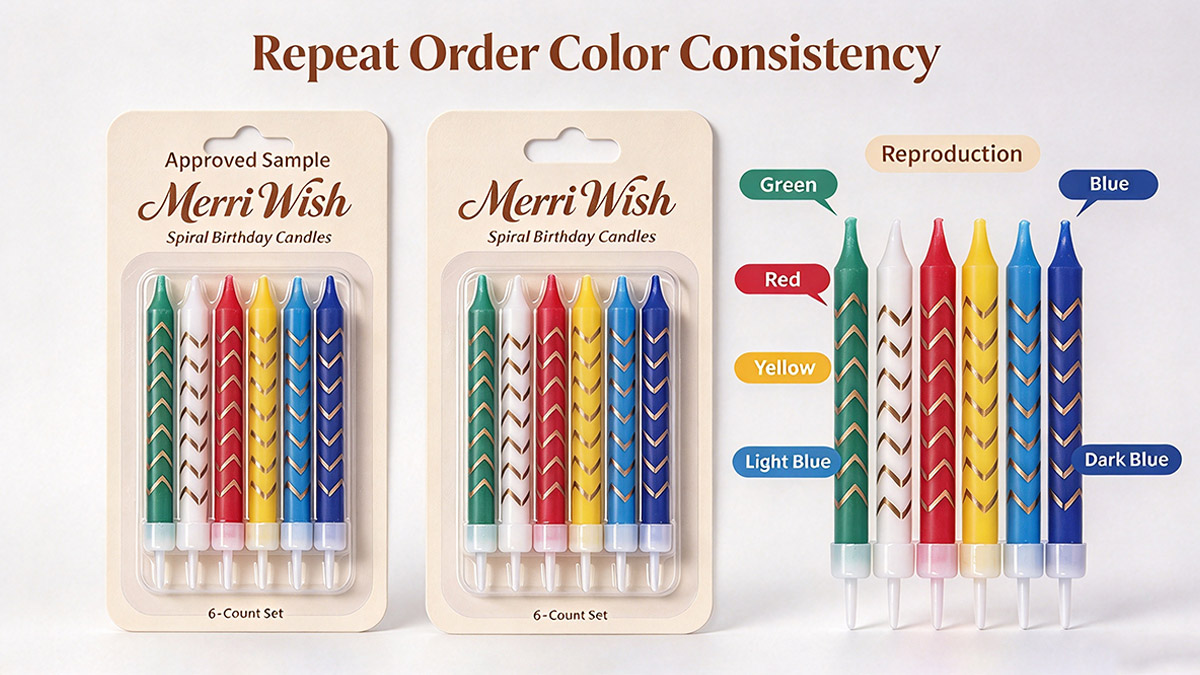
With a multicolor candle set, the finished appearance depends on more than the accuracy of each individual shade.
Green, white, red, yellow, sky blue, and dark blue need to work together as a combination. Their relative brightness, warmth, and visual balance contribute to the overall look of the set.
A difference in just one color can change that balance, even if the candle dimensions, spiral design, and packaging remain unchanged.
For the Mexican buyer, three potential problems needed particular attention:
A new batch could use the same color names but look different from the previously approved product.
An individual shade might appear acceptable on its own but look out of place beside the other five colors.
A difference discovered only after production and packing could leave less room to investigate and address it.
These concerns are relevant to any multicolor product intended for repeat orders. The challenge is not simply to reproduce six colors individually, but to maintain a recognizable appearance across the complete set.
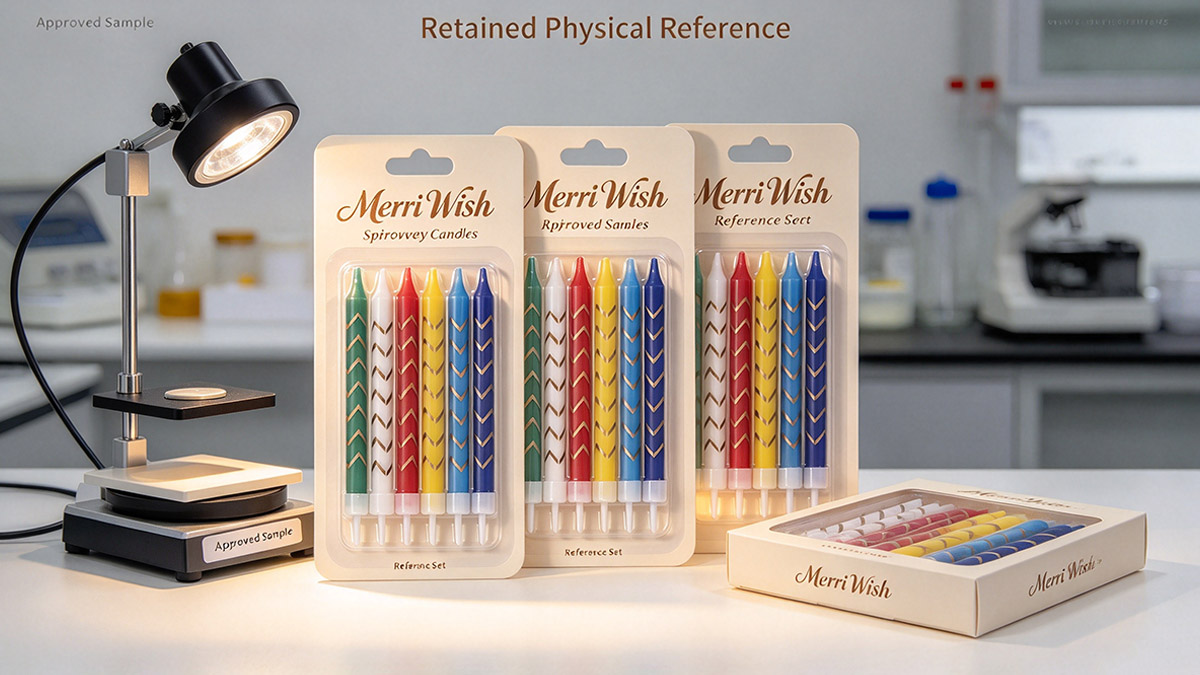
The first step was to establish a reference that could be used when reviewing future production.
After the initial order was approved, three complete sets were retained as physical reference samples. The samples were kept in their original packaging, under normal room-temperature conditions and away from direct light.
The reference record covered the following product details:
Approval date: August 2024
Initial order quantity: 12,000 sets
Candle specification: 7.5 cm spiral candles
Set configuration: Six candles per set
Color combination: Green, white, red, yellow, sky blue, and dark blue
Packaging: Printed color box
Retained samples: Three complete sets
Keeping physical reference samples provides a practical way to compare later production with the product that was originally approved. It also reduces reliance on color names, written descriptions, or photographs alone.
The distinction matters because a color reference on paper does not necessarily reproduce the appearance of colored wax. Material characteristics, surface appearance, lighting, and viewing conditions can all affect how a shade is perceived.
For this product, the approved physical sample serves as the reference for assessing both the individual colors and their combined appearance.
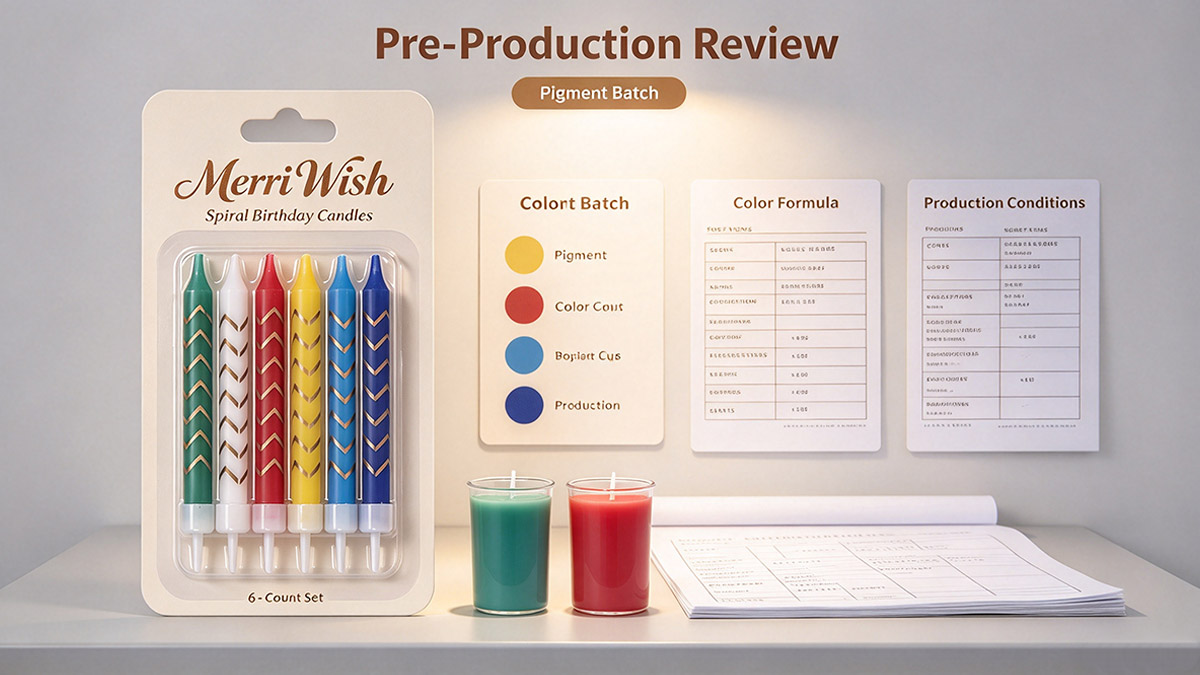
A reference sample is useful only when the production process is also managed carefully. Before a repeat run, several factors deserve attention because each can influence the finished color.
1. Pigment batch records
A change in pigment batch should not automatically be treated as equivalent to the previous material. The new batch needs to be assessed for suitability, with relevant records retained so that the materials used can be traced if a difference appears later.
2. Color formulation
The proportions of the colorants influence the resulting shade. Keeping the approved formulation and relevant process parameters consistent helps reduce avoidable variation between production runs.
3. Production conditions
Changes in equipment, production lines, or process conditions may also influence the finished appearance. Reviewing production records helps identify whether relevant conditions changed between the earlier and later runs.
These checks do not assume that a problem has occurred. Their purpose is to establish a clearer production history and make any difference easier to investigate.
If a new batch looks different from the retained sample, the manufacturer can review the available material and process records instead of relying on a visual description alone.
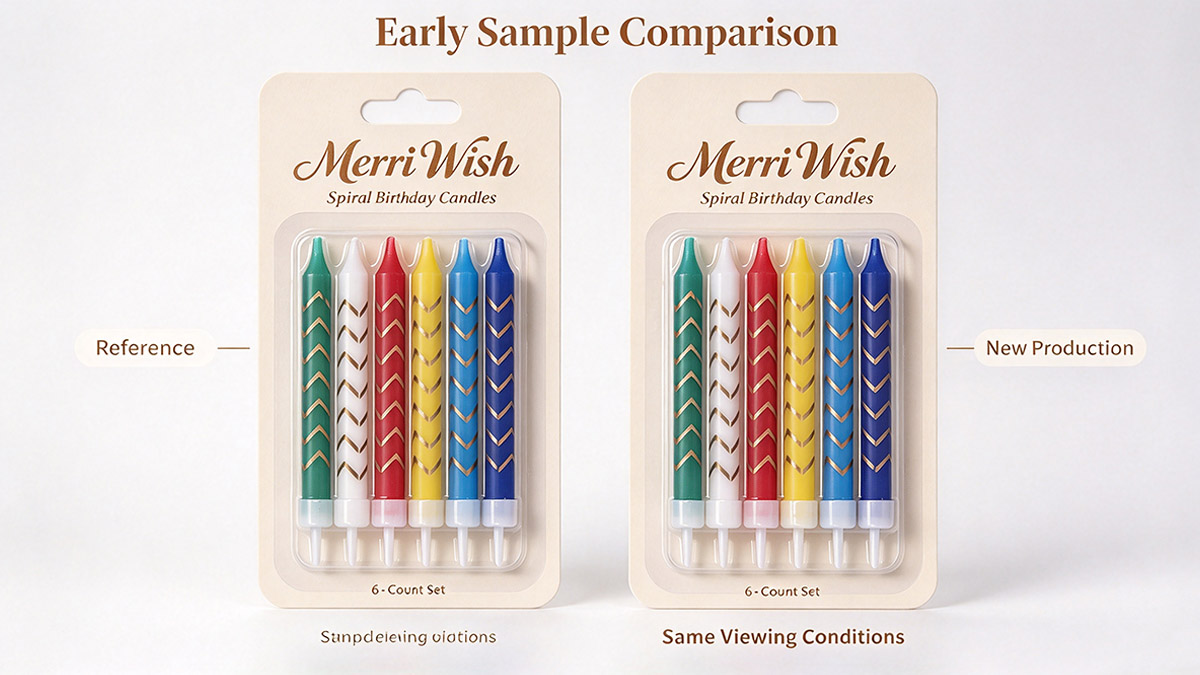
Photographs are convenient when a buyer and manufacturer are working across different countries. They can communicate the general appearance of a product and support an initial review.
However, photographs alone are not a reliable basis for judging subtle color differences. Lighting, camera settings, white balance, and screen displays can all affect how a shade appears.
For this reason, physical comparisons are particularly useful for repeat-order products.
During the early stage of repeat production, five sample sets were taken for comparison with the previously approved reference. The review considered the individual shades as well as the appearance of all six colors together.
This second part matters. A shade that appears acceptable when examined separately may look noticeably different when placed beside the other candles in the set.
The samples were compared under consistent viewing conditions, providing a more practical basis for reviewing the new production than photographs alone.
Early confirmation also creates an opportunity to identify a difference before the entire order has been completed. If a concern arises, the relevant samples and production records can be reviewed while there is still time to assess the issue.
Early-stage checks and final inspection serve different purposes.
The early comparison focuses on whether the new production is consistent with the approved reference. Final inspection assesses the completed order against the agreed requirements and sampling plan.
For this six-color spiral candle set, the final review should consider the approved reference, the appearance of the colors within each set, and the relevant production records.
The agreed sampling plan determines how many finished products are inspected. The inspection criteria should also be clear enough for both parties to understand how a difference will be evaluated.
Traceability connects these checks. When retained samples, pigment batch information, and production records are available for the relevant run, a discrepancy can be investigated with more context.
This approach does not mean every candle will be visually identical. Small variations can occur in manufacturing. The objective is to manage those variables, assess the finished product against an agreed standard, and make decisions using a consistent reference.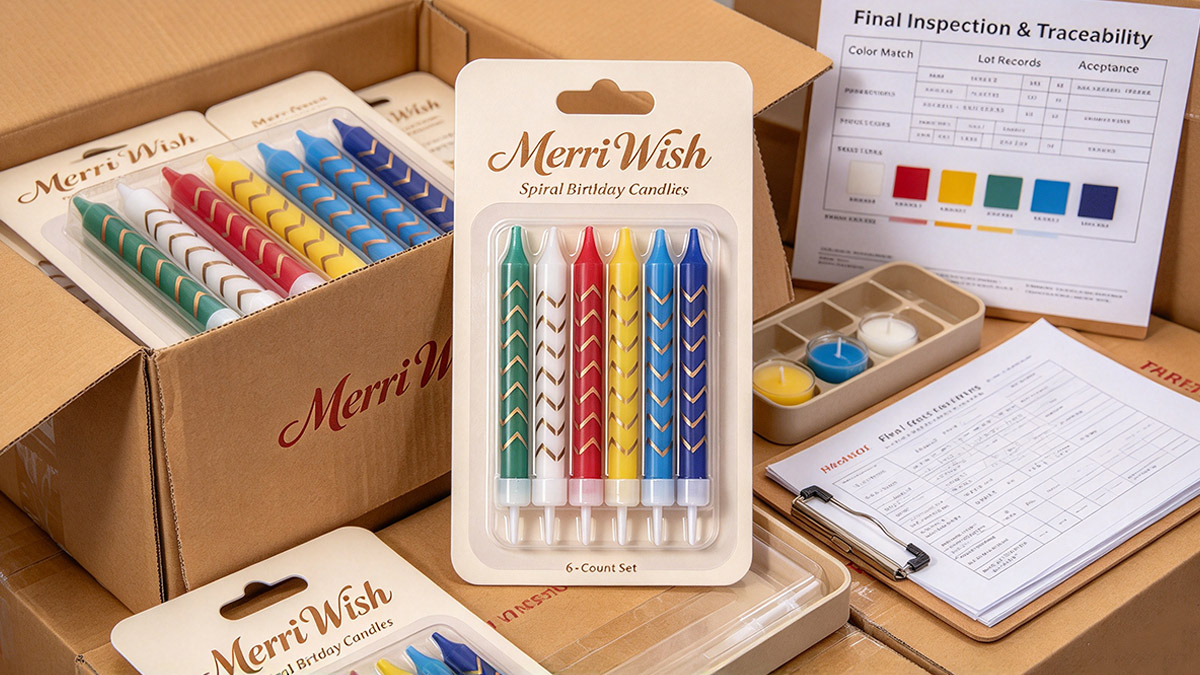
For the Mexican wholesaler, the six-color spiral candle set needed to remain recognizable as the same product across repeat orders. That required more than carrying forward the original product name and color descriptions.
Three practical elements are central to this approach:
A retained physical reference: Approved sets provide a basis for comparing later production.
A review of production variables: Pigment batches, color formulation, and production conditions are relevant to maintaining consistency.
Checks at different stages: Early production samples and final inspection provide opportunities to assess the product before and after the full run.
Together, these measures provide a more traceable way to review repeat production and evaluate potential differences.
The broader lesson is straightforward: product approval should not end with the first order. For a multicolor product, the approved sample needs to remain connected to the materials, production process, and finished goods that follow.
Before placing a repeat order, buyers and manufacturers can clarify four questions:
Which physical sample defines the approved appearance?
Have any relevant materials, pigments, equipment, or process conditions changed?
At what stage will the new production be checked?
How will individual colors and the complete set be evaluated?
These questions do not require an unnecessarily complicated quality system. They help both parties establish what consistency means for the product and how it will be assessed.
For a six-color spiral birthday candle set, the aim is not to promise perfect color matching. It is to make repeat production more predictable by keeping the original approval, production records, and finished product connected.
Hebei Kelaisi Crafts Co., Ltd. was established in 2009 and is part of a group with a history of candle manufacturing dating back to 1991. Kelaisi specializes in birthday candles and related products, supporting international customers with product development, manufacturing, and applicable quality and compliance documentation.
 Big size decorative scented candle
 Christmas Scented Candles Gifts Sets for Women
 happy birthday long thin glitter cake candles
 Luxury Golden Birthday Number Candle Sets
 Fancy cake decoration number annual birthday candle
 Gradient color Soy Wax Glass Jar Scented Candle
 Origami Style Vertical Pattern Wine Glasses Jar Candles
 Custom Mini Glass Jar Scented Candle
 3D Letter Happy Birthday Candles
 Decorative Birthday Candles
 St. Patrick's Day Decorations Set
 Christmas Party Balloons Supplies