Oct. 22, 2026
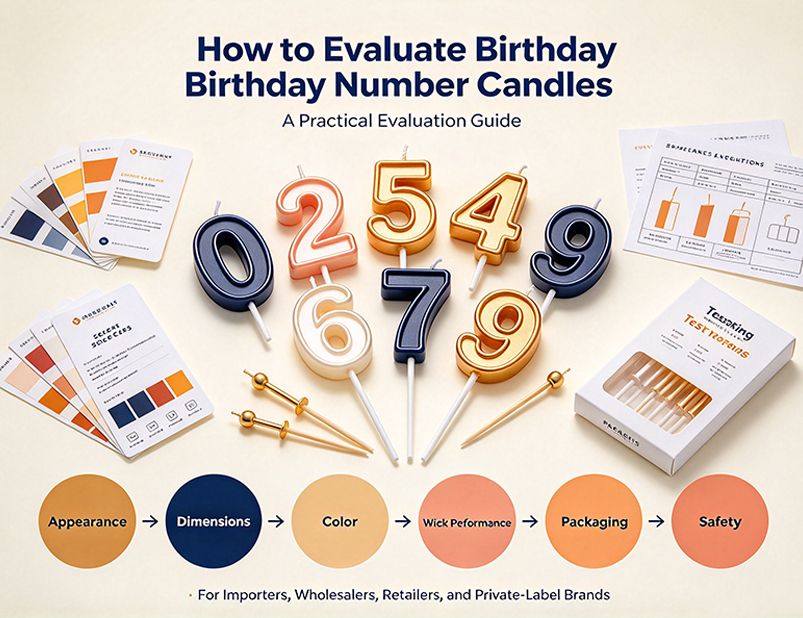
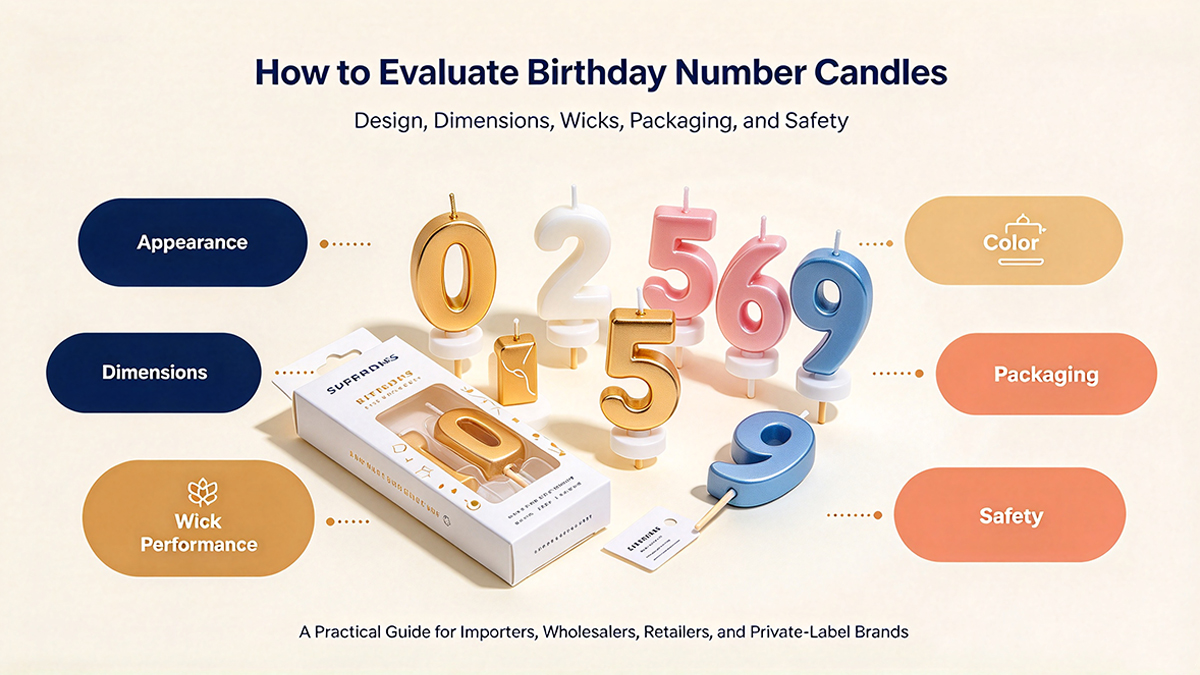
Birthday number candles are a familiar part of birthday celebrations, but evaluating them for wholesale, retail, or private-label orders involves more than choosing a number and a color. Product appearance, dimensions, color consistency, wick performance, packaging, and applicable safety requirements all deserve attention.
For importers and distributors, defining these requirements before production can help reduce misunderstandings, improve consistency between orders, and make quality checks more practical. The following guide explains what buyers should consider when evaluating birthday number candles.
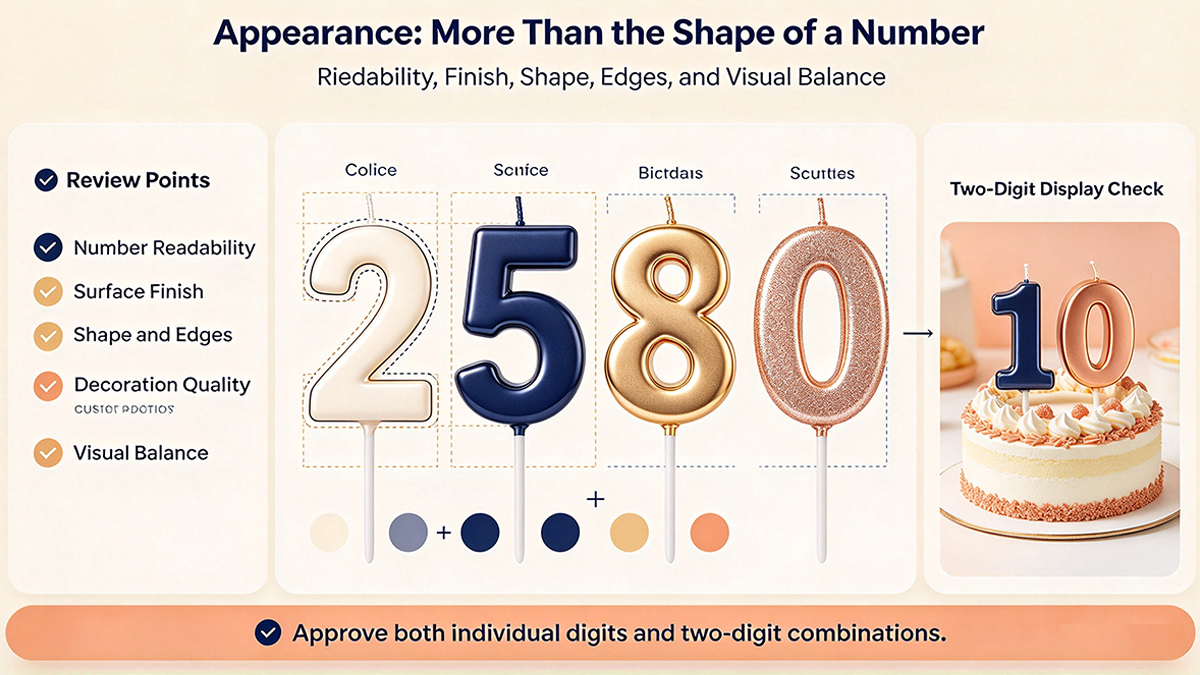
The appearance of a birthday number candle affects how clearly it communicates the intended age and how well it fits the overall cake presentation.
First, check whether each number is easy to recognize. The shape of the number should remain clear, including details such as the opening in a 6 or 9 and the curves of a 2, 3, or 8. If the design includes decorative patterns, glitter, colored coatings, or other surface treatments, confirm that these details do not make the number difficult to read.
Surface quality also matters. Buyers should examine the candle for visible cracks, uneven surfaces, unwanted marks, or inconsistent finishes. The edges and contours should match the approved design as closely as practical.
For customized products, a reference sample or approved drawing provides a useful basis for comparison. Both parties should understand which visual details are essential and which minor variations are acceptable. This is particularly important when a design contains multiple decorative elements or when several numbers are produced as one product series.
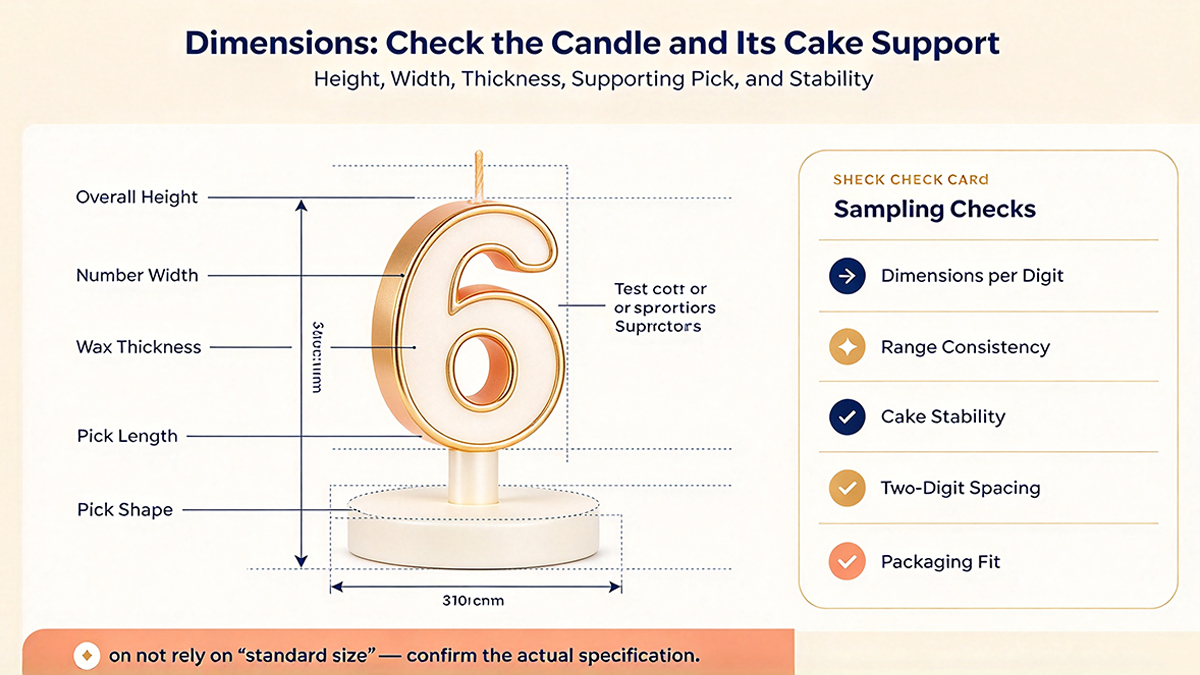
A candle's stated height does not necessarily describe its full size or how it will sit on a cake. Buyers should clarify the overall height, width, thickness, and dimensions of the supporting pick or stem.
These details influence the product's appearance, handling, and suitability for its intended use. A number candle that looks balanced in a product photograph may appear different when placed beside a cake topper or other decorations.
The support design deserves separate attention. Buyers should check whether the candle can be inserted as intended and whether the support is suitable for the product's shape and weight. Stability should be evaluated under appropriate test conditions rather than assumed from appearance alone.
For two-digit combinations, consider whether the two candles look proportionate when displayed together. Their heights, widths, and visual weight should be compatible with the intended presentation.
Before ordering, document the agreed dimensions and tolerances. If the product is customized, confirm whether measurements refer to the wax number alone or include the support. This simple distinction can prevent avoidable differences between the buyer's expectations and the delivered product.
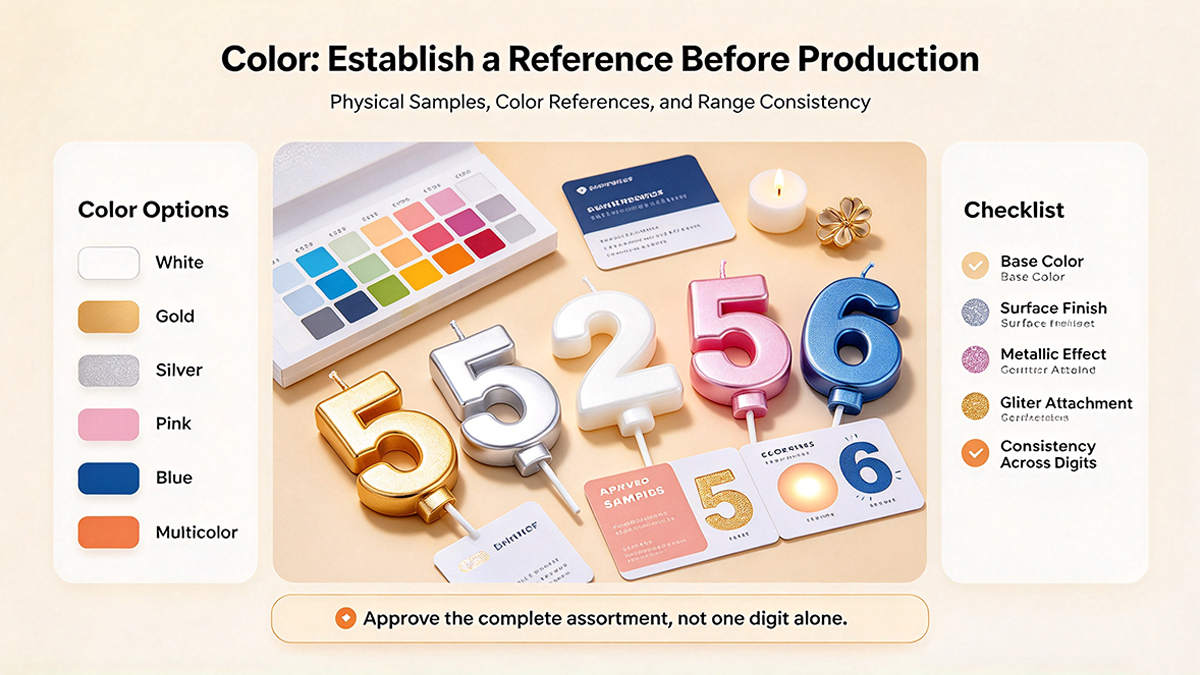
Color names such as gold, pink, blue, or purple can mean different things to different people. Even when buyers and manufacturers use the same color name, their interpretations may not be identical.
For this reason, color references should be defined as clearly as possible. Depending on the product and production process, buyers may use an approved physical sample, a suitable color reference, or another agreed specification. Screen images can help communicate an initial preference, but they may not accurately represent the final product because of differences in lighting, displays, and image processing.
When placing repeat orders, compare the new production batch with the retained approved sample where appropriate. If the product contains several colors, check each color individually rather than relying on an overall visual impression.
The acceptable degree of variation should be agreed upon before production. Some differences may arise from materials or manufacturing conditions, so expectations should be realistic and specific to the product. Clear reference samples and documented approval procedures make color checks more consistent across orders.
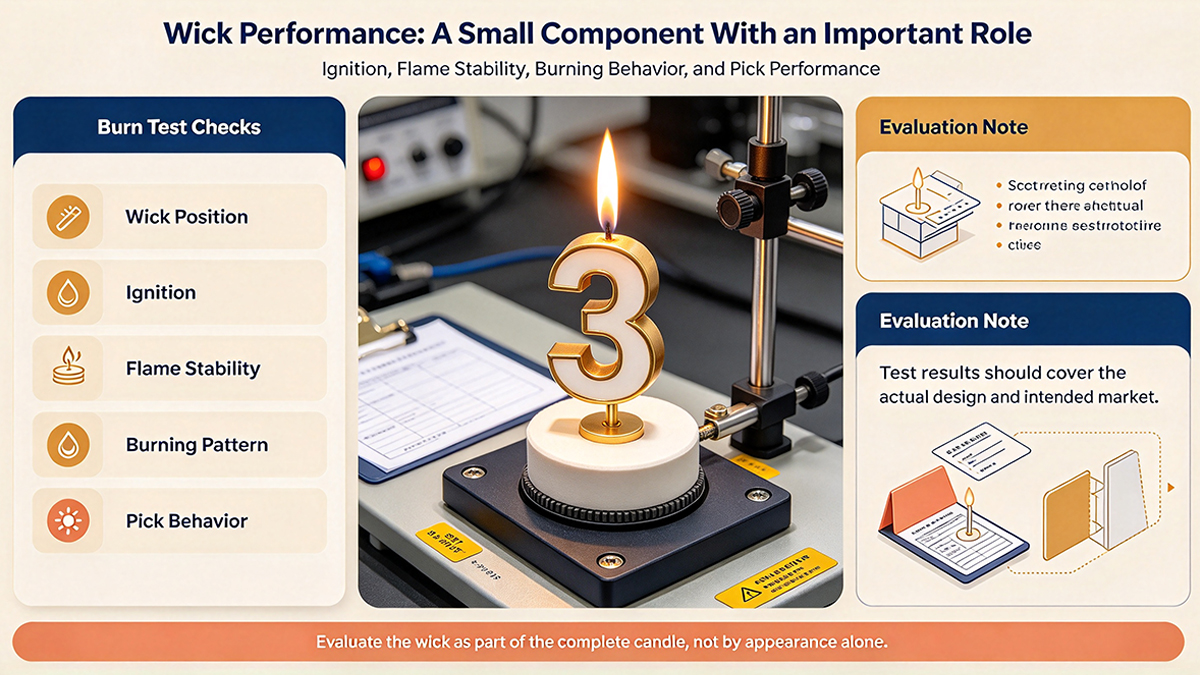
The wick is a small component, but its position and burning behavior are important parts of product evaluation.
Buyers should check whether the wick is positioned consistently and whether its visible length and placement match the approved product specification. A wick that is noticeably off-center or poorly secured may indicate a manufacturing inconsistency that deserves further inspection.
Burning performance should be evaluated using an appropriate test procedure for the actual candle design. Relevant observations may include ignition, flame behavior, burning duration, dripping, and the way the candle behaves during use. The appropriate criteria depend on the product's construction and intended application.
Testing should not rely on an isolated observation alone. Where applicable, use defined conditions and representative samples, and record the results. Any unusual behavior should be reviewed before the product is approved for production or shipment.
Buyers should also avoid assuming that every birthday candle uses the same wick material or construction. Requirements and checks should reflect the actual product. Manufacturers and buyers should confirm relevant material restrictions and safety requirements for the intended destination market.
Packaging affects both product protection and the efficiency of distribution. Birthday number candles should be packed in a way that helps prevent avoidable damage, deformation, contamination, or unwanted contact between products during handling and transportation.
When reviewing packaging, buyers should confirm the quantity per retail pack, the arrangement of the candles, and whether the package protects the product adequately. If the candles are sold in individual boxes or sets, the packaging should keep the numbers identifiable and make the intended contents clear.
For retail products, labeling, barcodes, and other identification details should follow the buyer's requirements and any applicable local rules. These details should be checked against the approved artwork before mass production.
Carton packing also deserves attention. Buyers may need to confirm the number of retail packs per carton, carton dimensions, gross weight, and whether the packing arrangement suits their storage and shipping plans. If the product or packaging changes after sampling, these details may need to be reviewed again.
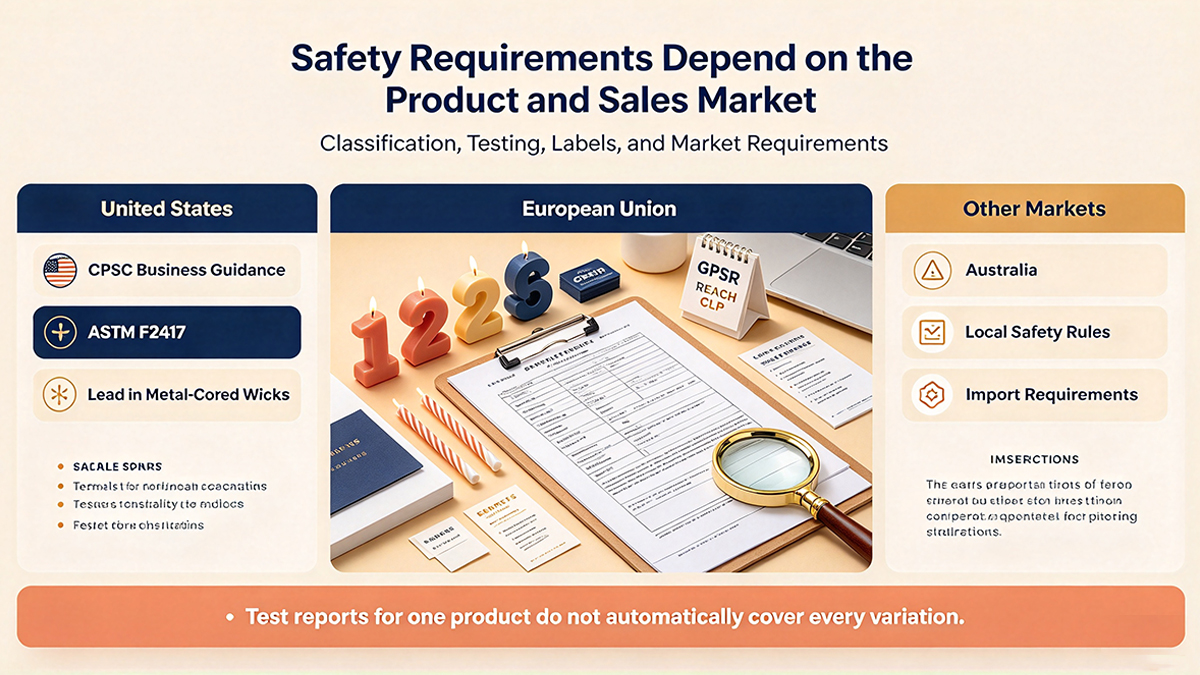
Safety requirements should be assessed according to the actual product, its materials and construction, its intended use, and the destination market. A standard relevant to one candle category may not apply to birthday number candles, and compliance with one requirement should not automatically be described as universal certification.
For the United States, buyers should identify applicable federal requirements and review relevant candle safety standards within their actual scope. For example, ASTM F2417 addresses fire safety for candles, while ASTM F2058 concerns candle fire safety labeling and may not cover birthday candles within its scope. The current scope and applicability should be verified before either standard is included in a product specification. Requirements concerning wick materials may also be relevant, depending on the product's construction.
For products sold in the European Union, buyers should assess the applicable product-safety framework and any relevant chemical restrictions based on the product's composition and intended use. Requirements should not be assumed to apply identically to every material or product category.
A candle used at a child's birthday party is not automatically a children's product solely because of that setting. Its classification and obligations depend on the applicable rules and the product's intended purpose and marketing.
For other destinations, buyers should confirm the relevant local requirements before finalizing the order. Where necessary, consult a qualified compliance professional or the responsible regulatory authority.
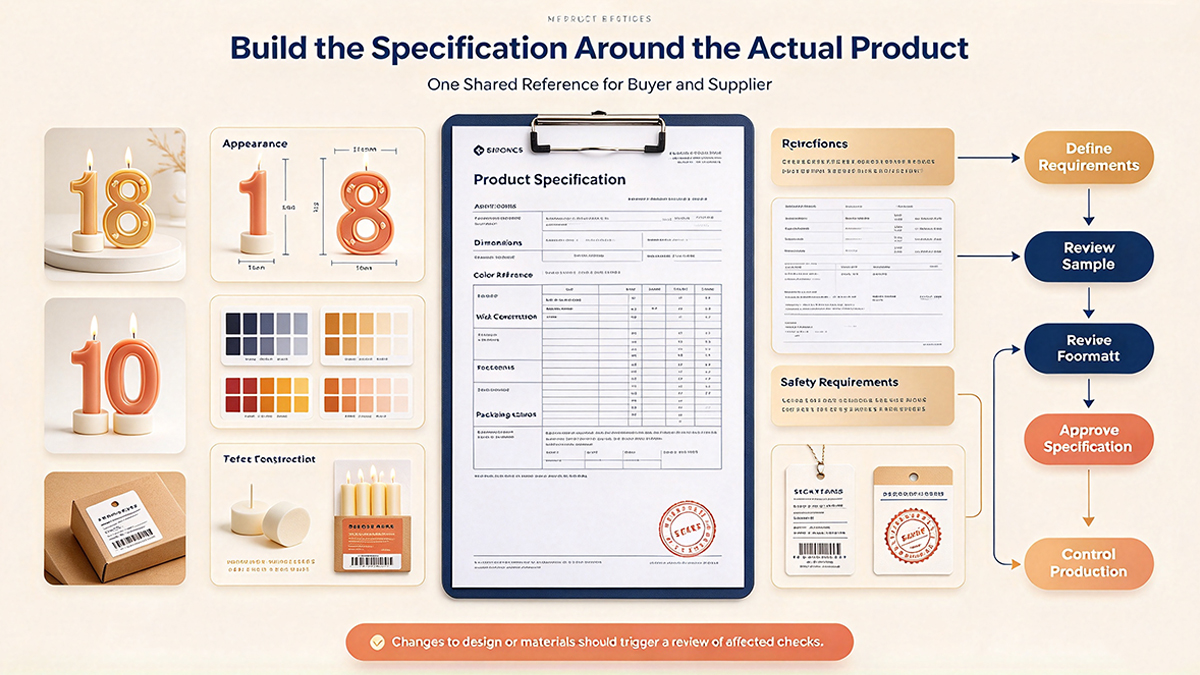
A reliable birthday number candle specification should bring the main requirements together: appearance, dimensions, color references, wick details, packaging, inspection criteria, and applicable safety obligations.
Buyers should agree on these details with the manufacturer before mass production and retain approved samples or documents when appropriate. If a change is made to the design, material, wick, or packaging, the relevant requirements should be reviewed again.
The goal is not to apply the longest possible checklist to every product. It is to identify the checks that matter for the actual candle and its intended market. Clear specifications help buyers and manufacturers evaluate the same product against the same expectations, supporting more consistent purchasing decisions and quality management.
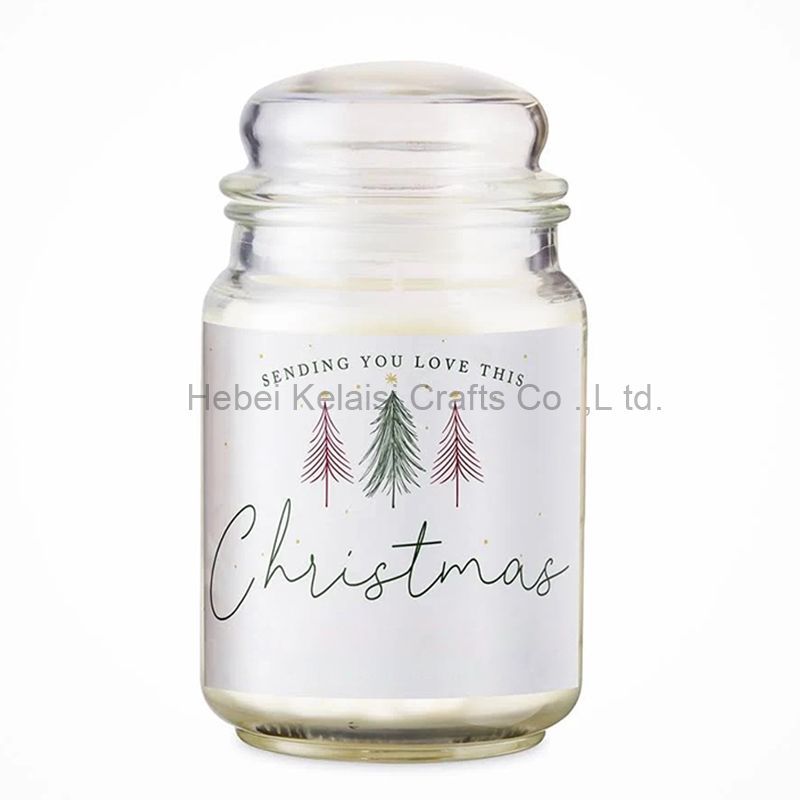 Big size decorative scented candle
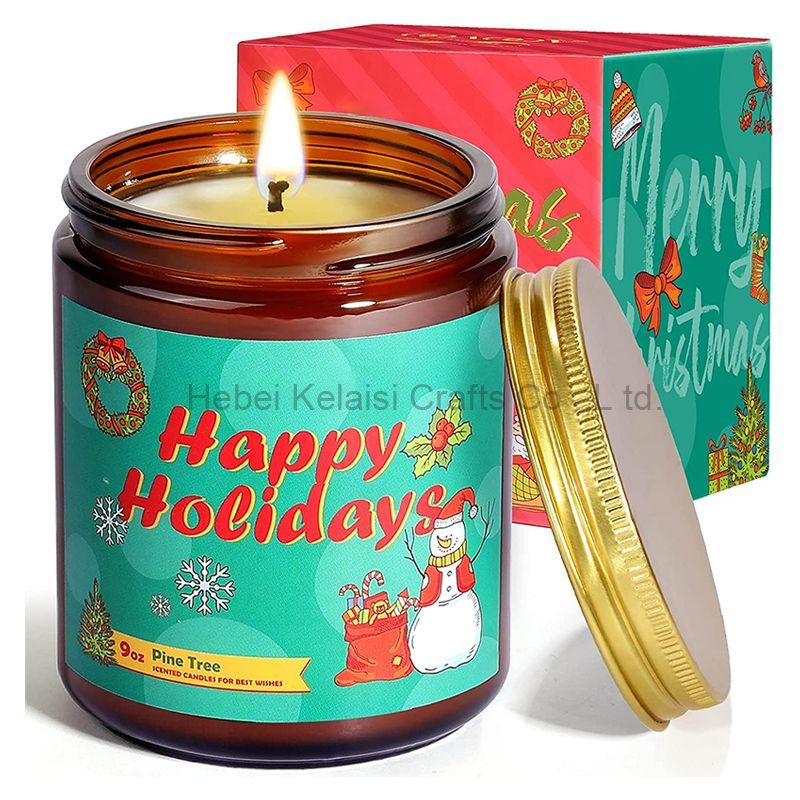 Christmas Scented Candles Gifts Sets for Women
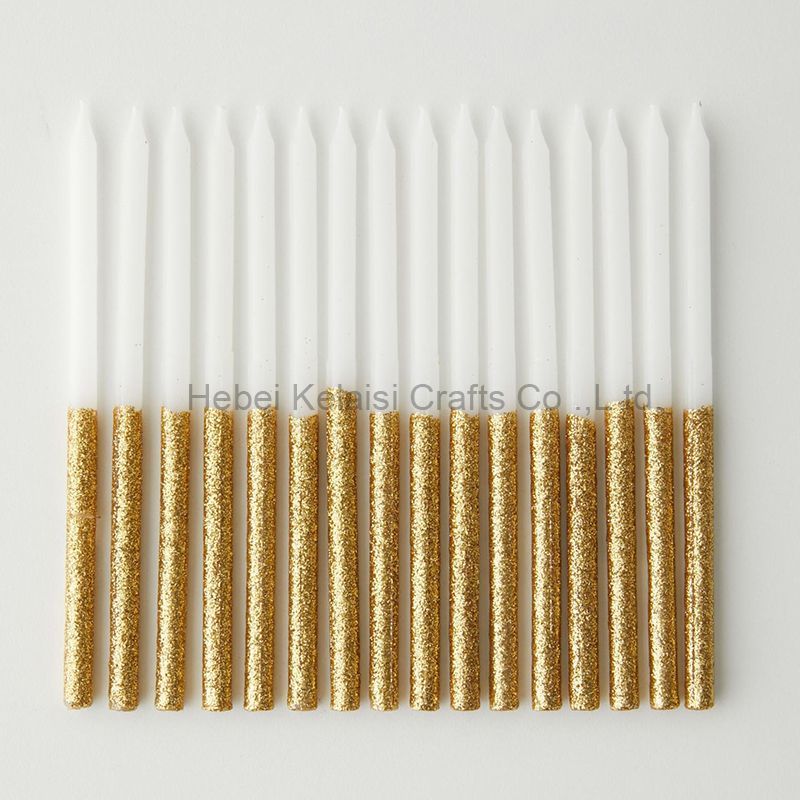 happy birthday long thin glitter cake candles
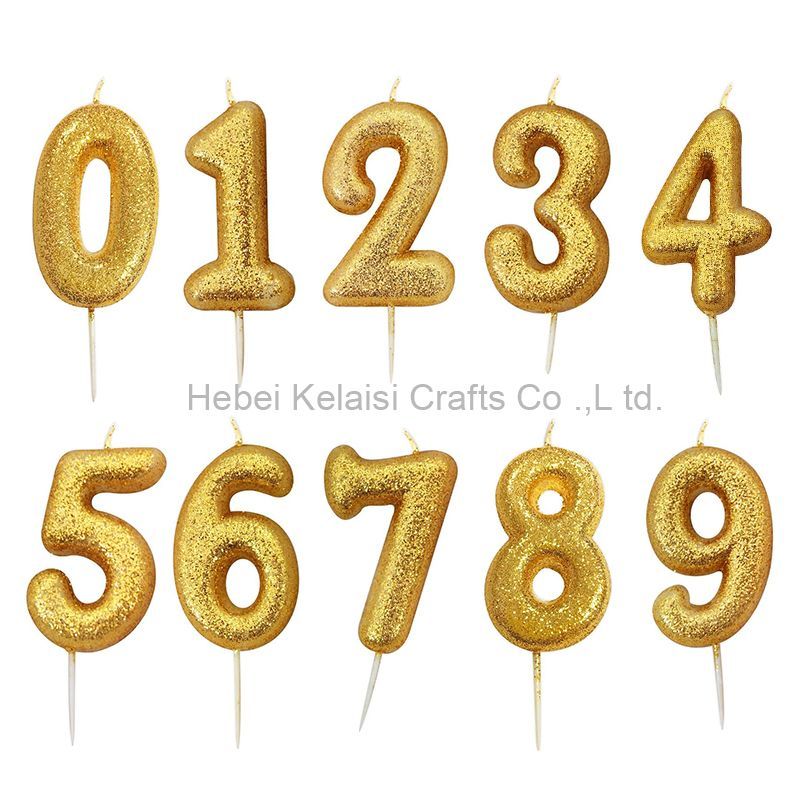 Luxury Golden Birthday Number Candle Sets
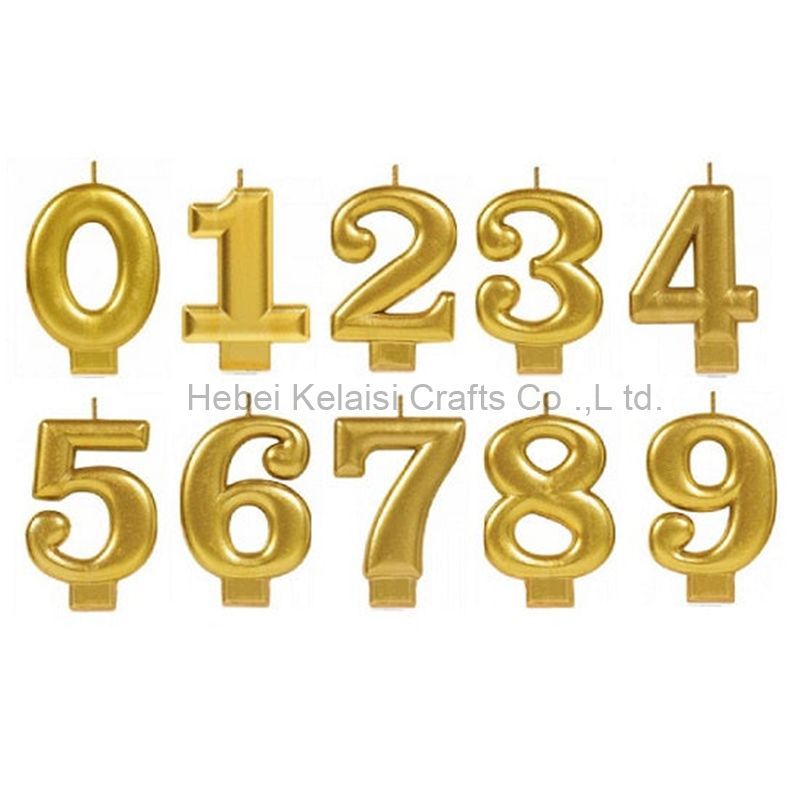 Fancy cake decoration number annual birthday candle
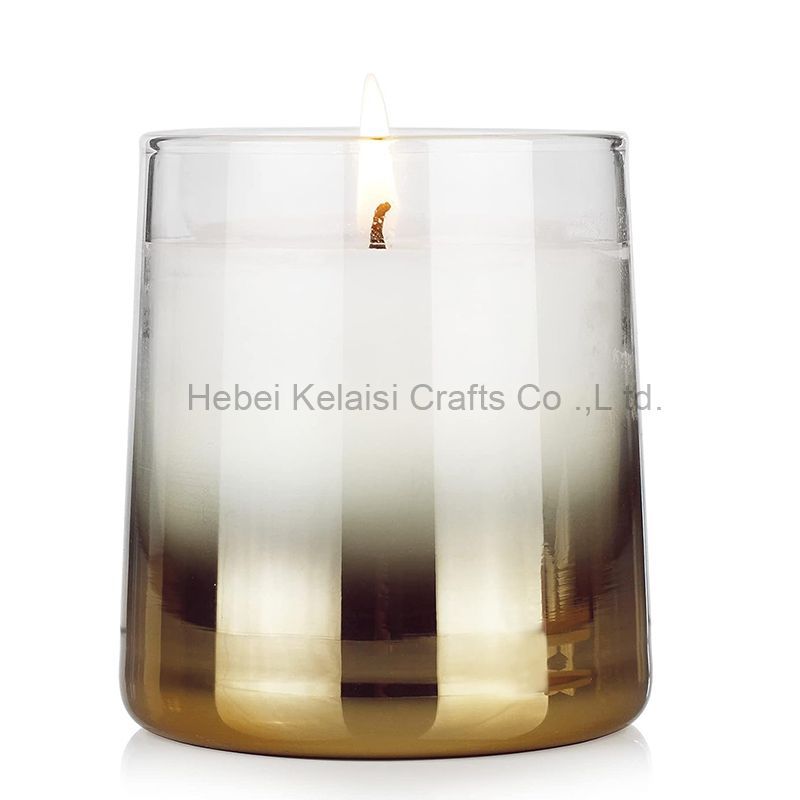 Gradient color Soy Wax Glass Jar Scented Candle
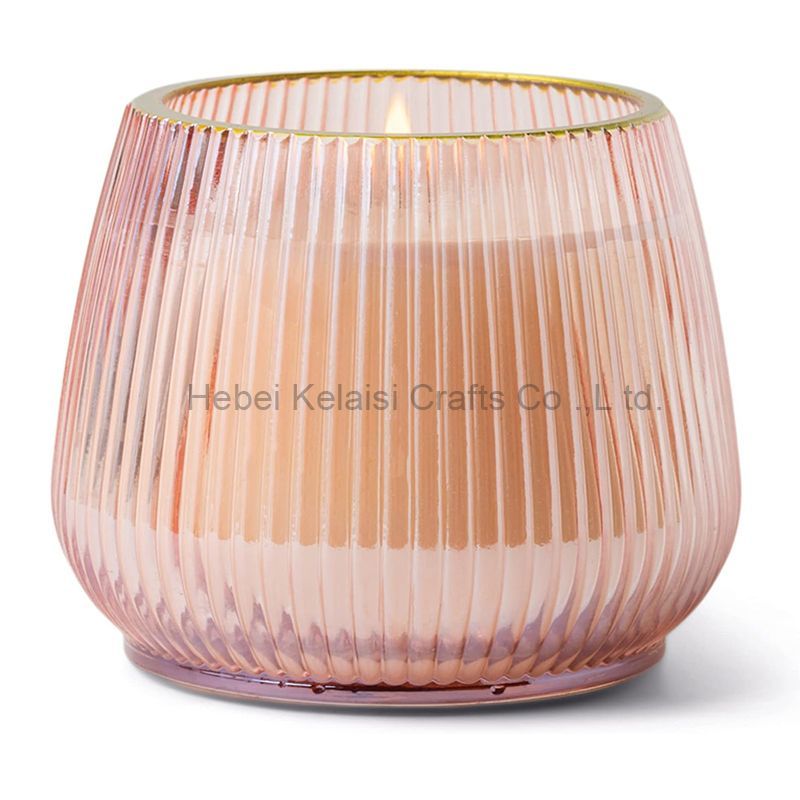 Origami Style Vertical Pattern Wine Glasses Jar Candles
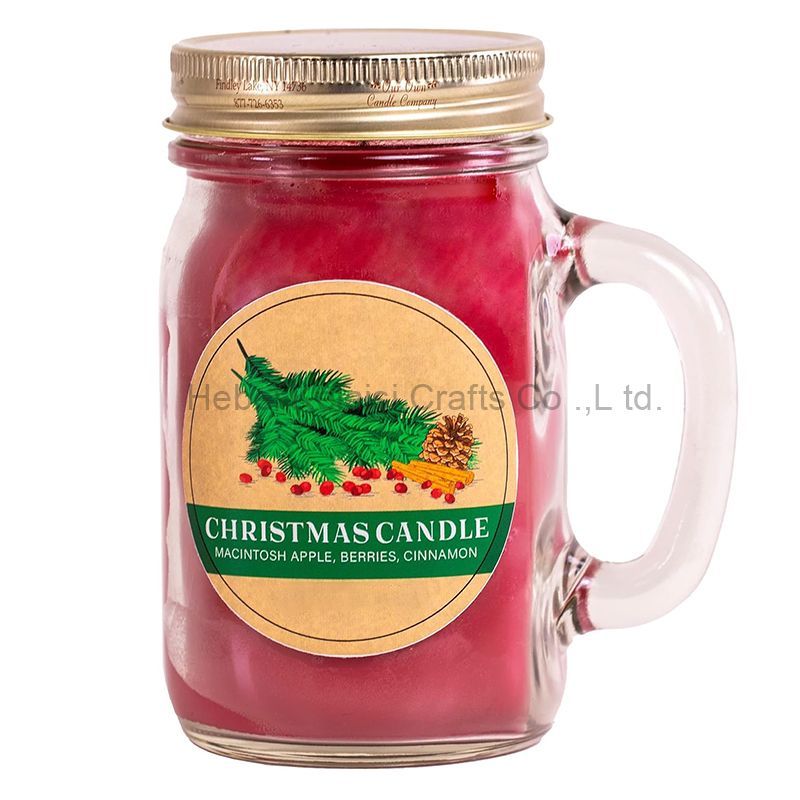 Custom Mini Glass Jar Scented Candle
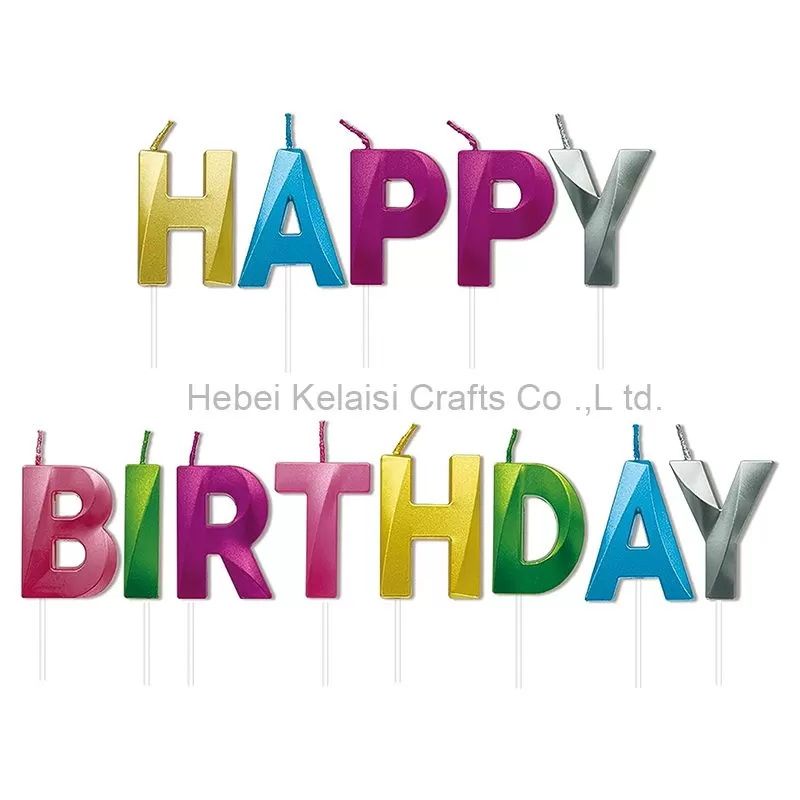 3D Letter Happy Birthday Candles
 Decorative Birthday Candles
 St. Patrick's Day Decorations Set
 Christmas Party Balloons Supplies